Quick answer: At the U.S. average home electricity price of about 18 cents per kWh, a typical EV costs about 6 cents per mile to drive, or roughly $60 per 1,000 miles. A 30-mpg gas car costs about 12 cents per mile with gasoline at $3.64 a gallon. Fast charging at the U.S. average of about 54 cents per kWh raises an EV’s cost to about 16 cents per mile.
Last reviewed: November 24, 2026 · Data checked November 2026
Cost per mile is the simplest way to compare driving an EV with a gas car, or to compare charging at home with public charging. Here is the formula and a set of worked examples.
The EV cost-per-mile formula
Cost per mile = (kWh per 100 miles × 1.1 × electricity price per kWh) ÷ 100
- kWh per 100 miles is your car’s efficiency; find it on fueleconomy.gov. A typical EV uses about 30 kWh per 100 miles.
- 1.1 adds about 10% for charging losses.
- Electricity price is your all-in price per kWh: your total bill divided by the kWh you used.
Example: 30 × 1.1 × $0.1819 ÷ 100 = = $0.060 per mile.
EV cost per mile by electricity price
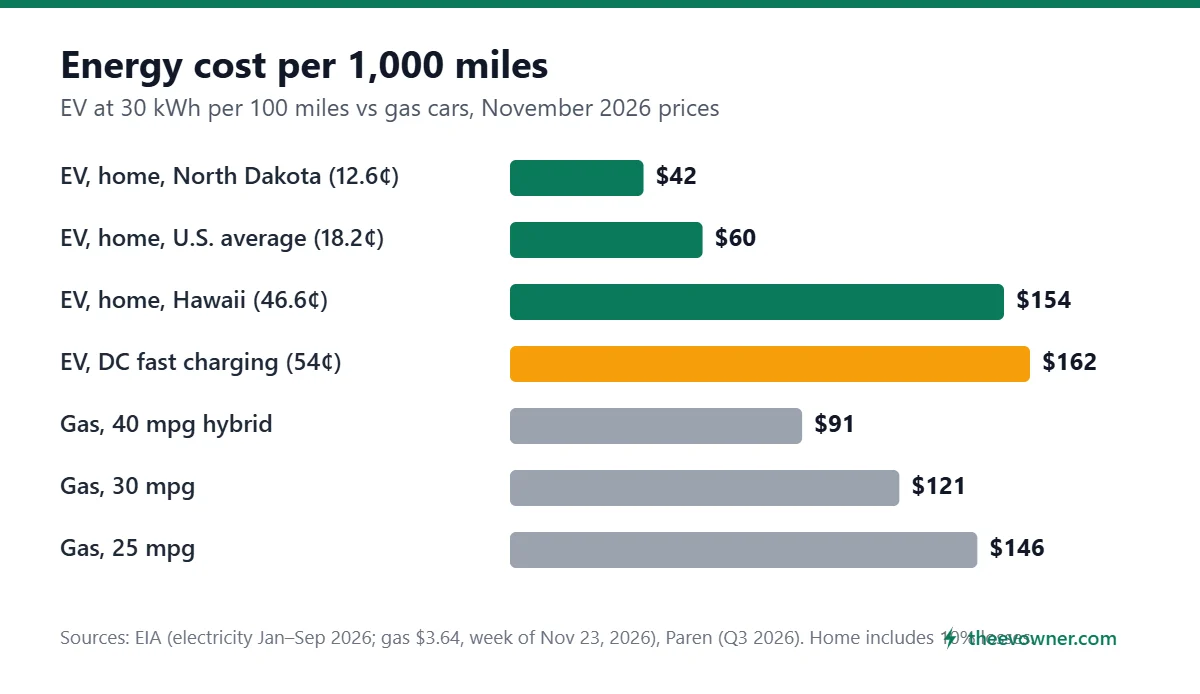
| Where you charge | Price per kWh | Cost per mile | Cost per 1,000 miles |
|---|---|---|---|
| Home, lowest state average (North Dakota) | 12.6 cents | 4.2 cents | $42 |
| Home, U.S. average | 18.2 cents | 6.0 cents | $60 |
| Home, higher-priced utility | 30 cents | 9.9 cents | $99 |
| Home, highest state average (Hawaii) | 46.6 cents | 15.4 cents | $154 |
| DC fast charging (U.S. average, Q3 2026) | 54 cents | 16.2 cents | $162 |
📍 See every state: our EV vs gas cost by state table shows what 1,000 miles costs in an EV and a gas car in all 50 states and D.C., updated monthly.
Assumes 30 kWh per 100 miles plus 10% charging losses. State averages are from the U.S. Energy Information Administration (EIA); fast-charging prices vary by network and location.
Gas car cost per mile
Cost per mile = gas price per gallon ÷ miles per gallon
| Gas car efficiency | Cost per mile at $3.64/gal | Cost per 1,000 miles |
|---|---|---|
| 25 mpg | 14.6 cents | $146 |
| 30 mpg | 12.1 cents | $121 |
| 40 mpg (hybrid) | 9.1 cents | $91 |
The U.S. average price of regular gasoline was $3.64 a gallon in the week of November 23, 2026, down from about $4.00 earlier in the month, according to the EIA.
What this means
- Charging at home at average prices costs less than half as much per mile as a 30-mpg gas car.
- Relying on fast charging can cost about the same as, or more than, a gas car.
- High electricity prices narrow the gap; a time-of-use plan can help.
How to lower your EV cost per mile
- Charge at home overnight on an off-peak or EV rate.
- Use fast chargers only on trips, and consider a membership plan if you fast-charge often.
- Drive efficiently: high speeds and cold weather increase energy use. See winter range loss.
- Check free workplace or destination charging near you.
🧮 Run your own numbers: our free EV vs gas cost calculator uses 2026 electricity prices for your state and shows how much you could save each month and over five years.
Frequently asked questions
Does EV cost per mile include maintenance?
No. This is energy cost only. EVs also tend to have lower maintenance costs; see our EV maintenance schedule.
How do I find my car’s kWh per 100 miles?
Look up your model on fueleconomy.gov, or check the trip computer, which often shows miles per kWh. To convert, divide 100 by miles per kWh: 3.5 miles per kWh is about 29 kWh per 100 miles.
Is fast charging always more expensive than gas?
Not always, but often. At the U.S. average fast-charging price of about 54 cents per kWh, a typical EV costs about 16 cents per mile, more than a 25-mpg gas car at $3.64 a gallon (about 14.6 cents). Cheaper networks, memberships and off-peak pricing can bring it below the cost of gas.
The bottom line
Charging at home is what makes EVs cheap to run. At average prices, you pay about 6 cents per mile, compared with about 12 cents for a 30-mpg gas car. See how much it costs to charge at home and EV vs gas monthly fuel cost.