Quick answer: A time-of-use (TOU) rate charges different prices for electricity depending on the time of day. Because most EVs charge overnight, an EV or TOU rate with cheap overnight or off-peak hours can cut your charging cost significantly. The key is to schedule charging outside the peak window, usually late afternoon and evening, and to check that the plan does not raise your costs for everything else in your home.
Last reviewed: November 24, 2026 · Data checked November 2026
Most utilities now offer at least one time-of-use plan, and many offer a plan designed for EV owners. Choosing the right one can matter as much as which charger you buy.
How time-of-use rates work
- Peak hours are the most expensive, typically in the late afternoon and evening, such as 4 p.m. to 9 p.m.
- Off-peak hours are cheaper, often overnight.
- Super off-peak hours, where offered, are the cheapest, often overnight or midday when solar power is plentiful.
- Prices and windows can change by season and between weekdays and weekends.
Example: how big the difference can be
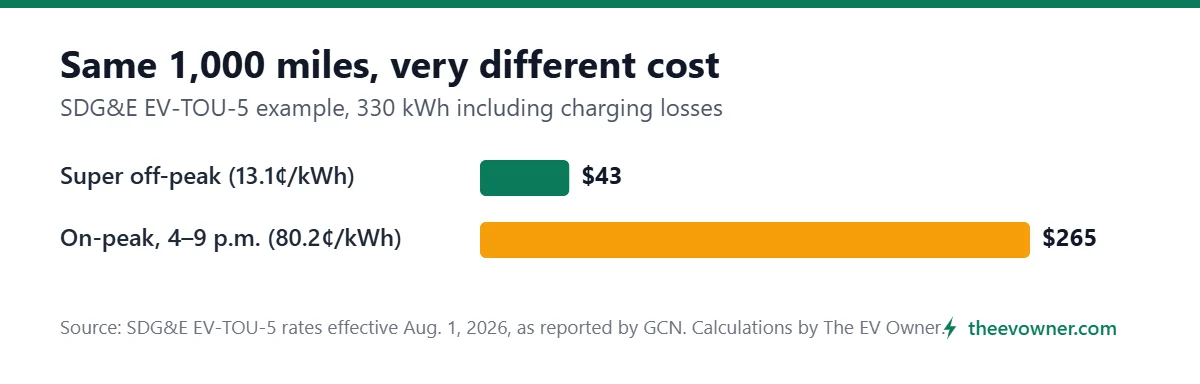
San Diego Gas & Electric’s EV-TOU-5 plan, effective August 1, 2026, prices super off-peak electricity at about 13.1 cents per kWh and on-peak at about 80.2 cents per kWh, according to reporting on the new rates.
| Charging time | Price per kWh | Cost for 1,000 miles (330 kWh) |
|---|---|---|
| Super off-peak | 13.1 cents | $43 |
| On-peak (4–9 p.m.) | 80.2 cents | $265 |
Assumes 30 kWh per 100 miles plus 10% charging losses. This is an extreme example from a high-price utility; differences are smaller in most areas, but the principle is the same everywhere.
Prices also change over time. For example, Southern California Edison’s TOU-D-PRIME plan for EV, battery and heat pump households raised its winter off-peak price to about 30 cents per kWh for winter 2026, from about 24 cents the previous winter, according to Solar.com.
Types of EV-friendly rate plans
| Plan type | How it works | Best for |
|---|---|---|
| Whole-home TOU | One meter; all household use is priced by time of day | Homes that can shift laundry, dishwashing and charging |
| EV-specific TOU | Whole-home plan with very low overnight rates, sometimes with a higher fixed charge | High-mileage drivers who charge every night |
| Separately metered EV rate | A second meter for the charger only | Homes that want to keep the rest of the house on a standard plan |
| Managed charging programs | The utility or charger shifts charging automatically, often with a bill credit | Owners who want savings without managing schedules |
How to choose the best plan
- Get your usage data. Download your hourly usage from your utility account.
- Use the utility’s rate comparison tool. Most large utilities estimate your bill on each plan.
- Check the peak window. If you cook, cool or heat heavily during peak hours, a whole-home TOU plan could raise those costs.
- Look at fixed charges. Some EV plans have a higher daily or monthly charge that only pays off with enough charging.
- Confirm seasonal prices. Winter and summer rates can differ significantly.
- Schedule charging. Use your car’s app or a smart charger to start charging after the peak ends.
Common mistakes
- Plugging in after work without a schedule, which can mean charging during peak hours.
- Choosing an EV plan without checking the effect on the rest of your bill.
- Forgetting that rates change; review your plan at least once a year.
🔌 What will charging cost you? Try our free EV charging cost calculator with 2026 electricity prices for every state, home and fast charging.
Frequently asked questions
Do I need a smart charger for a TOU plan?
No. Most EVs can schedule charging from the car or its app. A smart charger adds features and may be required for some utility programs.
Will a TOU plan always save money?
Not always. It saves money if you can avoid using a lot of power during peak hours. Use your utility’s comparison tool before switching.
Can I switch back if the plan does not work for me?
Many utilities allow you to switch plans, sometimes with limits on how often. Check your utility’s rules.
The bottom line
A time-of-use or EV rate is one of the easiest ways to cut charging costs. Charge overnight or during super off-peak hours, check the impact on the rest of your bill and review rates each year. See EV cost per mile and how much an EV will raise your electric bill.