Quick answer: Before buying a used EV, get a battery state-of-health (SOH) report, compare the car’s real range at 100% with its original EPA range, check the remaining battery warranty, and look for signs of heavy DC fast charging or extreme heat. A healthy used EV typically shows a modest loss: at the average rate of about 2.3% per year, a five-year-old car would be around 88% to 89%.
Last reviewed: November 24, 2026 · Data checked November 2026
The battery is the most valuable part of an electric car, and its condition decides how much range you get and how much the car is worth. Unlike an engine, you cannot hear or feel battery wear on a test drive. Here is how to check it properly.
What battery health means
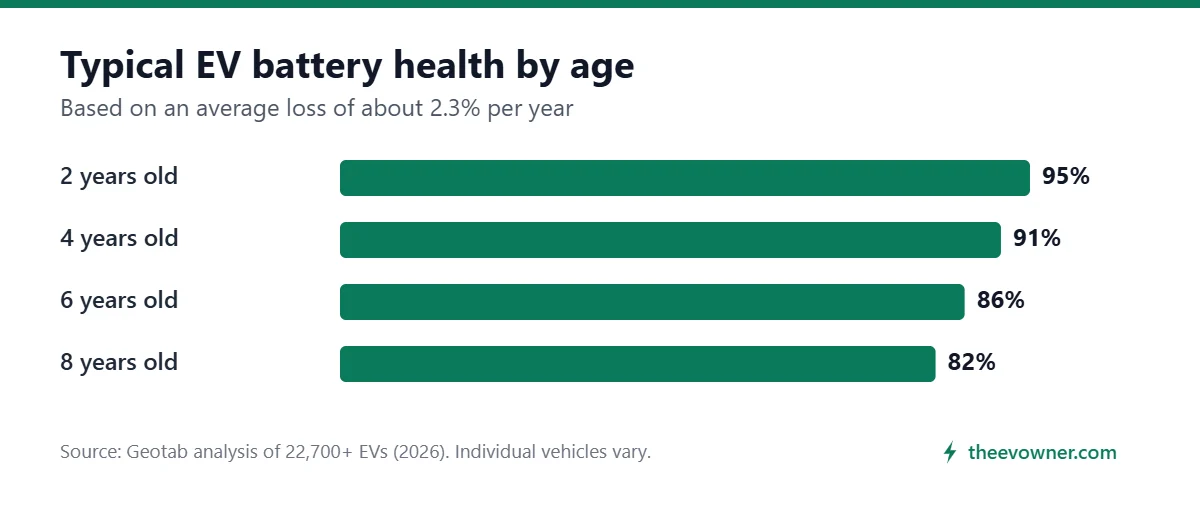
Battery health, or state of health (SOH), is the battery’s current usable capacity compared with when it was new. A battery at 90% SOH stores about 90% of the energy it did originally, so the car’s range is roughly 10% lower. Telematics company Geotab measured an average loss of about 2.3% per year across more than 22,700 EVs (Geotab).
What is a normal battery health for its age?
| Vehicle age | Typical battery health (average) | Worth a closer look if below |
|---|---|---|
| 2 years | About 95% | About 90% |
| 4 years | About 91% | About 85% |
| 6 years | About 86% | About 80% |
| 8 years | About 82% | About 75% |
Typical values use the 2.3% average. Thresholds are general guidance, not a pass or fail standard; some models lose more early on and then stabilize.
Step 1: Get a battery health report
- Ask the seller or dealer for a battery report. Many dealers can produce one with diagnostic tools.
- Ask a brand dealer to run a battery health check; some charge a fee.
- Use a third-party battery report service that reads the car’s data.
- Check the car’s own display. Some EVs show battery health or degradation information in a service menu.
Step 2: Check the real range
Charge the car to 100% (or ask the seller to), then note the range estimate. Compare it with the original EPA range for that model and trim. Remember that range estimates are influenced by recent driving and temperature, so treat this as a rough check alongside the battery report.
Step 3: Look at warranty coverage
Most automakers cover the battery for at least 8 years or 100,000 miles from the original sale, often including capacity loss below a threshold such as 70%. Check:
- The original sale date and current mileage.
- Whether coverage transfers to a second owner.
- What capacity level the warranty guarantees.
Step 4: Ask about charging and climate history
Questions to ask the seller:
- Did you mostly charge at home, or at DC fast chargers?
- Was the car kept in a hot climate or parked outdoors in direct sun?
- Did you usually charge to 100% and leave it full?
- Has the battery or charging system ever been repaired?
Heavy fast charging and heat are linked with faster degradation, according to Geotab’s 2026 study.
Step 5: Check recalls and service history
Look up the vehicle identification number (VIN) on the NHTSA recall website and ask for service records. Make sure any battery-related recalls have been completed.
Red flags
- The seller refuses a battery health check.
- Range at 100% is far below what similar cars of the same age show.
- Warning lights related to the battery or charging system.
- Very slow DC fast charging compared with the model’s normal speed.
- No service history and unknown charging habits.
🧮 Run your own numbers: our free EV vs gas cost calculator uses 2026 electricity prices for your state and shows how much you could save each month and over five years.
Frequently asked questions
Can I check battery health myself?
Partly. You can check the range at 100% and look for warning lights, but a proper battery report is the most reliable way to know the state of health.
Does a low battery health mean I should walk away?
Not necessarily. It should be reflected in the price, and you should make sure the remaining range covers your needs. If the battery is still under warranty, check how coverage applies.
Is high mileage bad for an EV battery?
Mileage matters less than charging habits and climate. A higher-mileage car that was charged mostly at home in a mild climate can have a healthier battery than a low-mileage car that was fast-charged in the heat.
The bottom line
Never buy a used EV without checking its battery. Get a health report, compare real range with the original rating, confirm warranty coverage and ask about charging and climate history. Read is buying a used EV a good idea and how long EV batteries last for more.